
Last few sessions, we started looking into how to add contrast to different lines. Today we will continue on that theme.
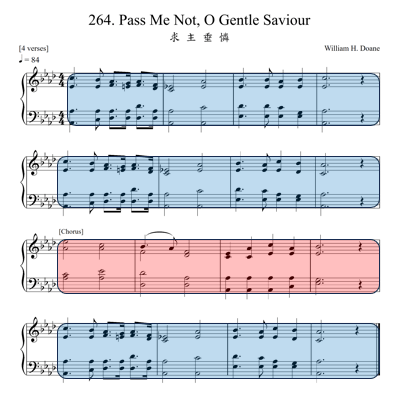
Hymn 264 Pass Me Not, O Gentle Saviour. This hymn has 4 lines. The melody and harmonies of Lines 1, 2 and 4 are more or less the same. Only the 1st line of the chorus is quite different.
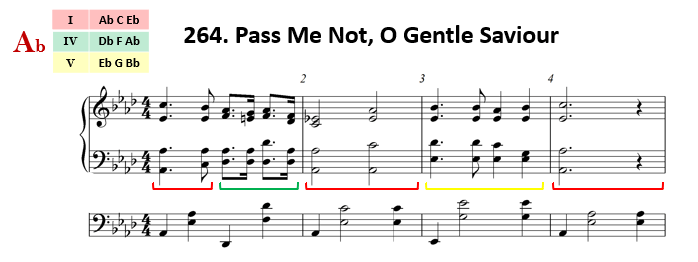
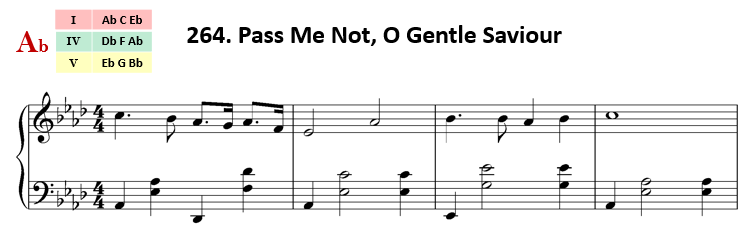
First, let us look at the harmonies of the first line. Bar 1: chord I and IV, bar 2: Chord I, bar 3: chord V, bar 4: chord I.
Bar 1 > 1st 2 beats, chord I, bass note and a chord, 3rd and 4th beat, chord IV, bass note and a chord.
Bar 2 > chord I, we can do a bass note and 3 chord in crotchets, or bass note and chord in minims. I prefer a bass note, a minim chord and a crotchet chord. See how the accompaniment aligning with the melody, the chords are in-between, creating a better flow and movement for the music.
Bar 3 > chord V, same pattern, a bass and 2 chords.
Bar 4 > bass and 2 chords
This can go for lines 1, 2 and 4.
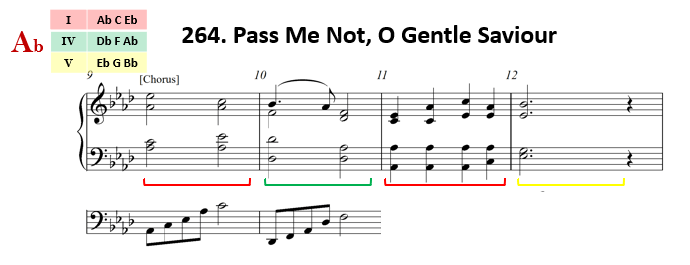
The harmonies for the 1st line of the chorus is chord I, chord IV, chord I and chord V. Rather than using the same style as previous lines, we are going to introduce quaver arpeggios. As there is one chord per bar, the maximum we can have would be 8 quavers. You can experiment this by trying out what it will sound like with different amount of quavers. For now, we will use 4 quavers and end with a minim for each bar.
Two points to bear in mind. “Firstly”, the spacing of the arpeggio needs to sound good, “Secondly”, it need to arrive on a note which will blend nicely with the melody.
For example, if we first play the arpeggio in bar 9: chord I, 5 notes in all, Ab C Eb Ab C. Bar 10: chord IV, Db F Ab Db F. When with the melody, you will notice the closeness of 1st 3 notes do not sound nice, sound quite low and deep. Also the last note lands on the same note as the right-hand melody.
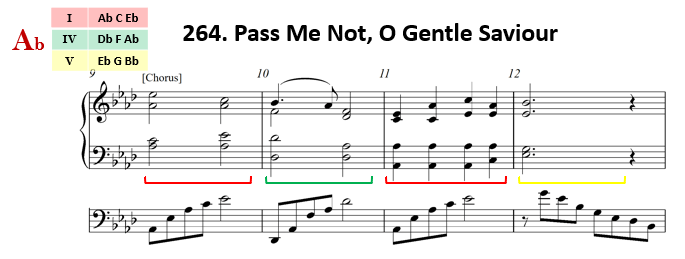
Bar 9 > therefore, it is better to space out the start of the arpeggio like Ab Eb Ab C for chord I, finishes Eb with the C on the right, forming a 6th.
Bar 10 > respacing chord IV arpeggio Db Ab F Ab, finishes Db with F on the right, forming a 3rd.
Also, you can see, although the starting note for each chord is different, they arrived more or less at the same region.
Bar 11 > We can do the same as bars 9 and 10
Bar 12 > we can bring in another contrast, instead of ascending arpeggio, we will have descending arpeggio. Play the melody on the 1st beat, then a descending arpeggio. Do your calculation so that it will arrive on Ab on the 1st beat on the following bar.
So if we go back to line one:
Remember we mentioned that we can do the same style for lines 1, 2 and 4 because they are similar? May be we can find another way so that we are not doing the same thing for 3 times. One of my favourite is this:
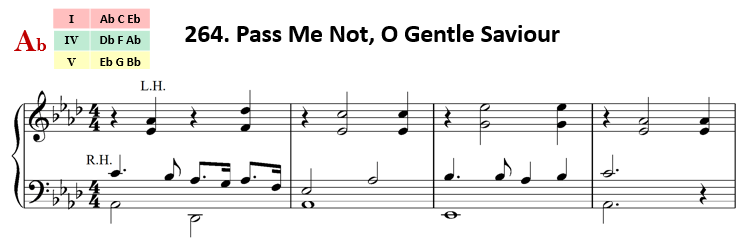
Moving the melody not up, but down an octave. Keeping the bass note still at the bottom, left hand crosses over the melody to do the chords. We can use this idea when we play the 2 lines for the verse.
To summarise > line 1 and 2, right-hand plays the melody an octave lower, will do cross over left-hand accompaniment. Move right-hand melody back to normal for chorus, line 3 with arpeggio patterns. Line 4 will use the previous style of a bass note and chords.
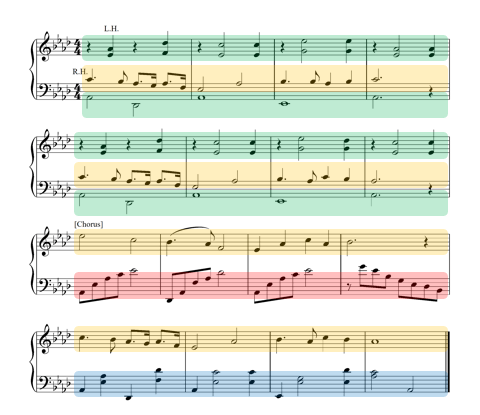
After going through what we can do for each line, this hymn will now look like:

I hope that you enjoy go through and learning this hymn together. Stay tune for the next session. Bye!

 Hosanna Praise
Leave a comment