
This time we will look into G major. Before we go any further, it would be great if we go through and practice the possible chord combinations for each of the chord I, IV and V.
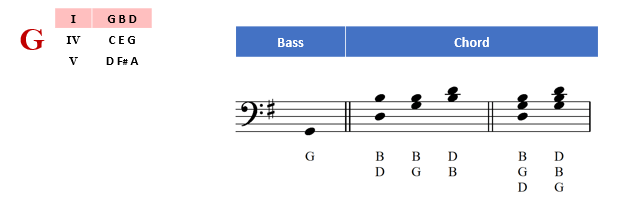
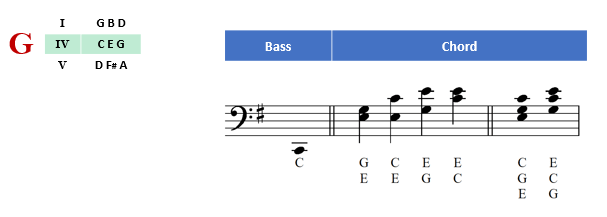
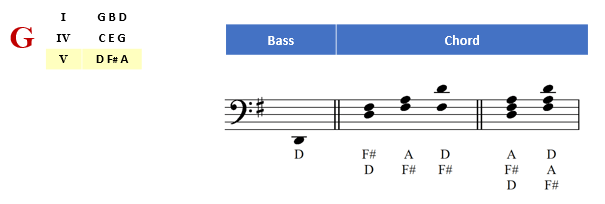
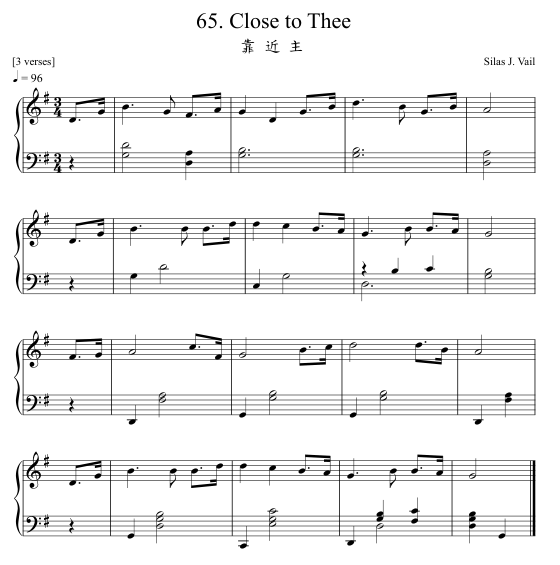
We will use hymn 65 Close to Thee as an exercise for creating a piano accompaniment. This hymn has 4 lines, rather than using the style bass note follows by a 2 or 3 notes chord as previous sessions, we are going to introduce some contrast through each line. Again, work out the harmony bar by bar, decide which chord to use.
In a chord [1st, 3rd and 5th], say G B and D chord I, the note “B” balances the chord, without it, it will sound bare and empty. Most of the time, if the melody has the 3rd, the accompaniment can do without and vice versa. Occasionally, leaving out the 3rd will make it sound different and special too.
Line 1 > a simple chord to accompany the right hand melody. e.g. bar 1 – 1st 2 beats GDGB is chord I, using a chord of a fifth will blend nicely with the B on the melody. Similarly on the 3rd bear, DADF# is chord V with F# on the melody, again a fifth will fit well. Bars 2 and 3 – chord I as before, this time put a chord with a B on the left hand. Bar 4 – round off with a fifth.
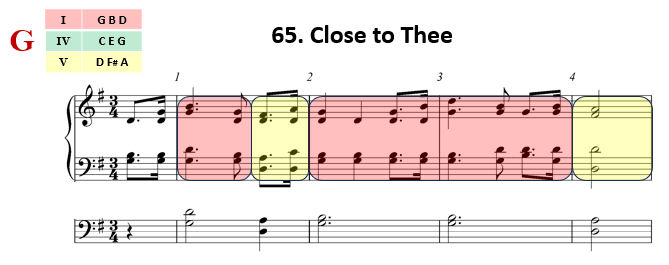
Line 2> break up the chord by using 2 to 3 single notes. e.g. bar 5 use a crotchet and minim rather than a chord as bar 1.
# For now, if there are one or two odd notes that are not in the chord, but the majority of notes are, 80/90%, then it is OK to use that chord. e.g. ignore the F natural on bar 5, DBA on bar 6, etc..
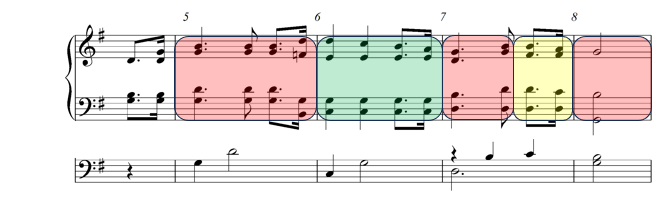
Line 3 > bass note follows by a 2 notes chord

Line 4 > bass note follows by a 3 notes chord. Round off the hymn with the opposite, chord than a bass note.
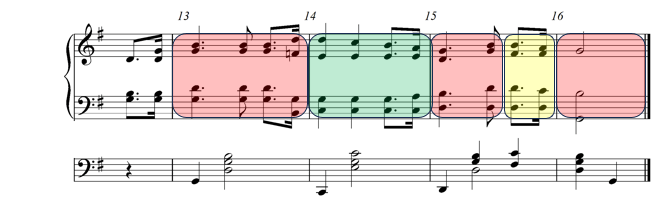
So after working out what to do for each bar and line, the outcome will be as below

 Hosanna Praise
Leave a comment