
Download Sheet Music 下載樂譜 version B
Hymn 228 Keepers of the Word Are Blessed, also know as “All for Jesus”. This hymn has 4 lines. The two lines of the verse are the same, and the two lines of the chorus are also the same.

First, let us look at the harmonies of the first line. Bars 1,2 and 4 are chord I, Bar 3 is chord V.
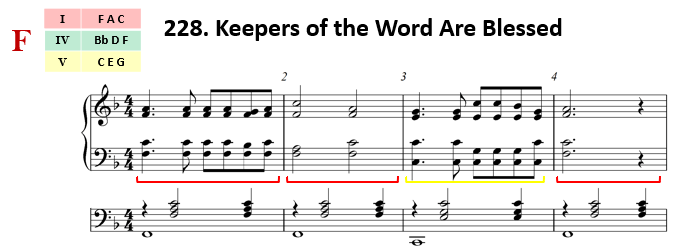
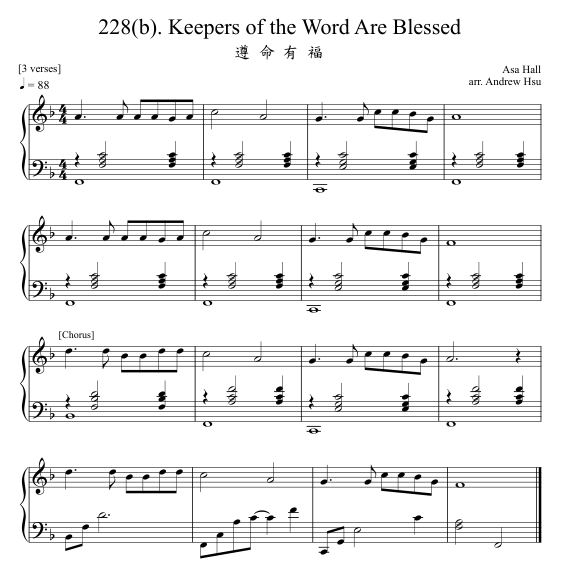
Bar 1 and bar 2 > chord I, a bass note and chords, one minim and one crotchet.
Bar 3 > chord V, same pattern, a bass and 2 chords.
Bar 4 > same as the 1st 3 bars, a bass and 2 chords. This can go for line 2 as well.
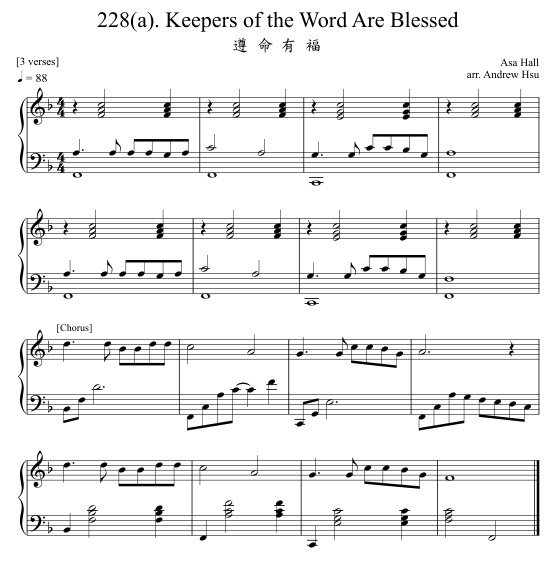
Last session, we shared the idea of bringing the right-hand melody down an octave, and splitting the left hand playing a bass note follows by crossing over the right-hand, playing the 2 chords above the melody, like this

You can practice both ways, the normal, or the cross-hand.

This works either way, it is up to you what you would like to do, I am just giving you some ideas.
Now the chorus. Chords for this line are chord IV, chord I, chord V and chord I again. We will use arpeggios for this line.
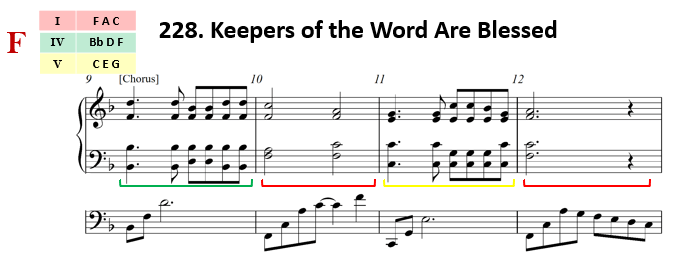
Bar 9 > notice the melody has a dotted crotchet follows by 5 quavers, we could do 8 quavers, or less, may be a mixture of quavers or crotchets? In the example, we will use 2 quavers and a minim.
Bar 10 > melody has 2 minims, we will use 4 quavers tied over a crotchet, and finishes with another crotchet.
* You can see from bar 9 and bar 10, I am filling up the longer space, the dotted crotchet and minims, with some movement on the left-hand, remember the idea of movement is important!
Bar 11 > we can do the same as bar 9.
Bar 12 > we can play ascending arpeggios like bars 9, 10 and 11. However, it may be more interesting if we reverse and play a descending passage. This needs a bit of calculation and working out so that the descending passage finishes on a Bb at the beginning of the next bar, a mixture of arpeggio and scale.
The fourth line, harmonies are the same as the previous line, line 3. To have a stronger ending to conclude this hymn, we will use the bass note and chords idea that we have been using previously.
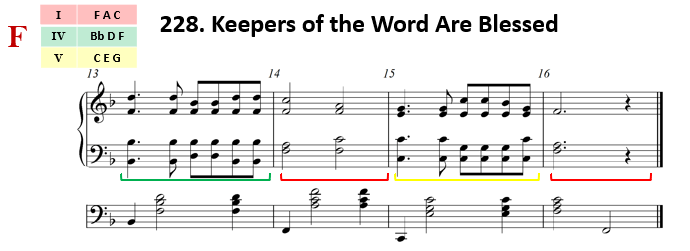
Bar 13 > chord IV, a bass note and 2 chords.
Bar 14 > chord I, a bass note and 2 chords.
Bar 15 > chord V, a bass note and 2 chords.
Bar 16 > chord I, we can do a reverse, a chord first, then a bass note.
So, take the 2 lines from the chorus, you may want to have a gentle start using arpeggios for the first line. Follows by a stronger ending using bass note and chords.
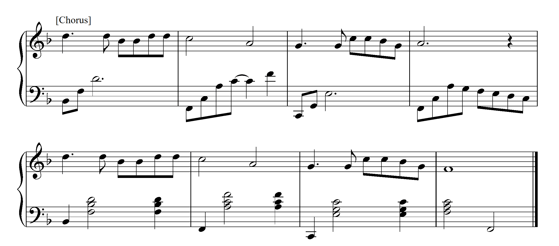
We can also do this
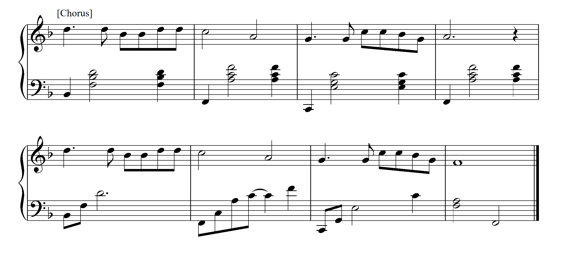
Play the bass note and chords for the 1st line, and arpeggios for the following line. It works equally well if we do the opposite. Beginning strong, rounding off with a softer ending. Of course, we then need to adjust the ending of these 2 lines to fit in correctly.
* Remember, these tutorial videos are providing ideas and suggestions for you to explore, there is really no right or wrong, you just have to try them out yourself.
To summarise, line 1 and 2, right-hand plays the melody an octave lower. We will do cross over left-hand accompaniment. Move right-hand melody back to normal for chorus, line 3 with arpeggio patterns. Line 4 will use the previous style of a bass note and chords.
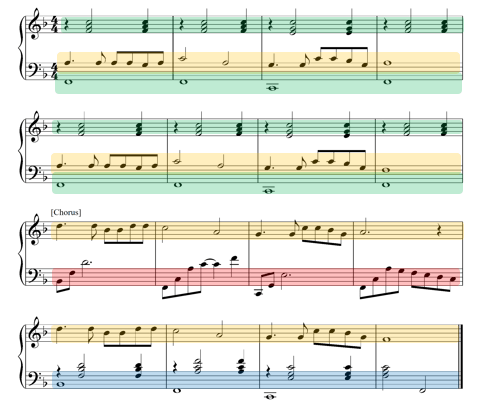
Below are version A and version B which you can switch round to suit the need.

 Hosanna Praise
Leave a comment