Piano Accompaniment 鋼琴伴奏 (8)

Download Sheet Music 下載樂譜 version C


Today, we will continue where we left off in making piano accompaniment for choir.

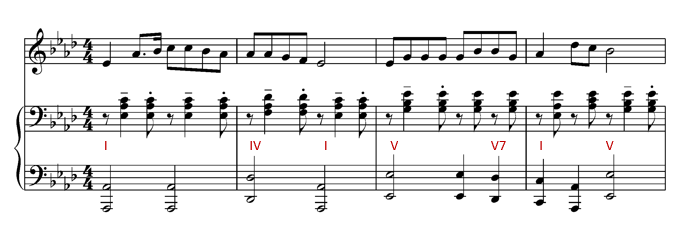
The new pattern we are looking at today in Ab major, chord I, Ab C Eb, left-hand plays an octave Ab and right-hand plays chords, crotchet and quaver. A little emphasis on the crotchet and a bounce for the quaver.
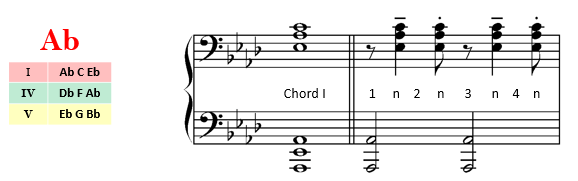
When we arrive half way through 3rd, here, the harmonies change every beat, so we will opt for single quaver chord and resume back to the former pattern midway 4th bar and thereafter.

Second line, same again,
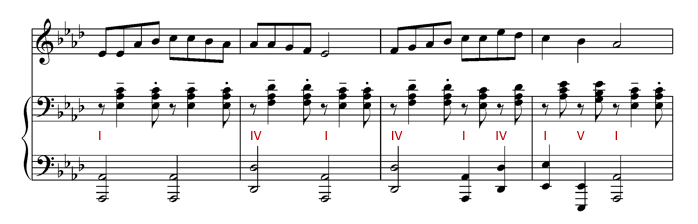
changes every beat in half way through 3rd bar till the end of 4th bar.

Line 3 chorus, remember when this tutorial series started, we use a bass note and chords on the left hand to accompany the right-hand melody?

Bar 9 > Same idea, if the choir can stay in tune and in time, take out the melody, left-hand plays the octave bass and right-hand plays the chords like this:

Bar 10 > there are 2 chords, so back to crotchets.

Bar 11 > also has 2 chords, we could carry on with crotchets as a choice.
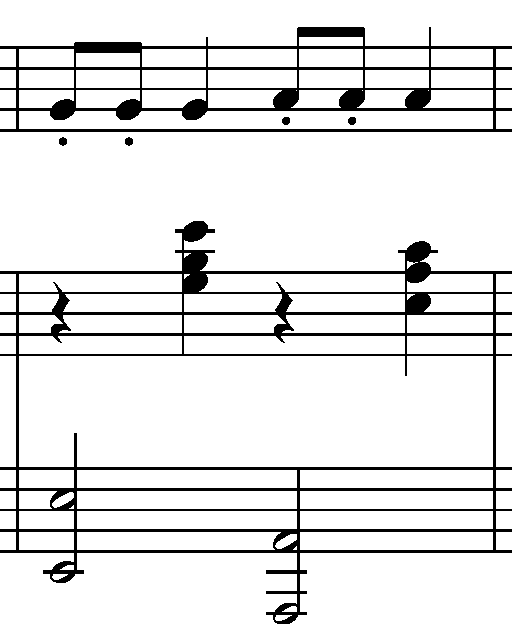
However, if we look at the melody, each note is repeated 3 times, we can try vary the pattern. Play together with the first note, allow the remaining 2 repeated notes to carry on, and fill the remaining quaver space with a chord. This will create movement and feel of moving forward onto the next beat.

Bar 4 > same again, we could use what we have done on the first bar.
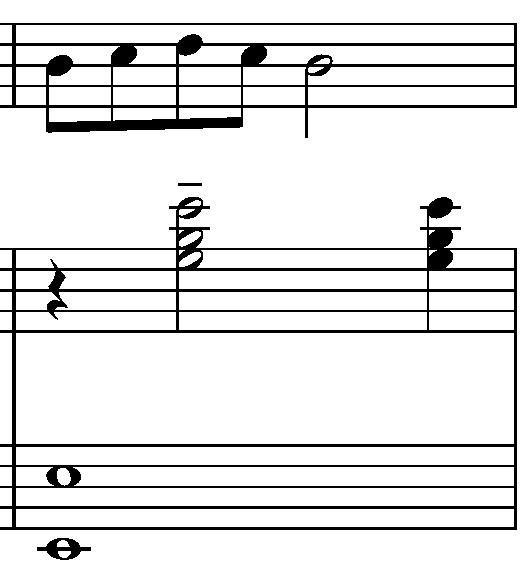
Quite often if the line finishes on chord V and the next line starts on chord I, we can link a descending scale from V to I. The left-hand can first play a minim follows by 4 quavers,
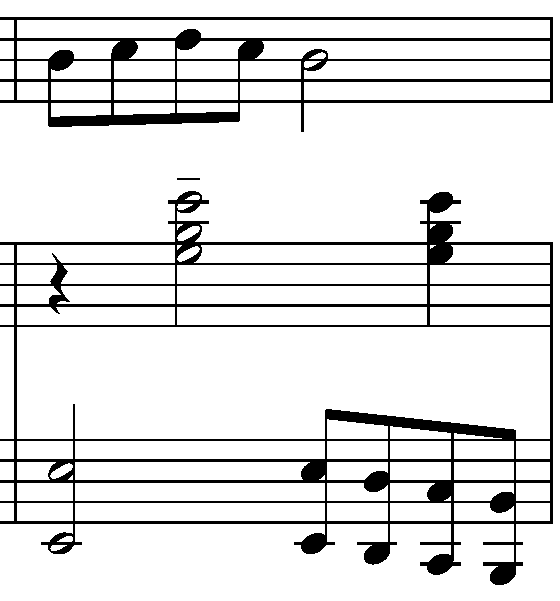
or a minim tied to a quaver follows by 3 more quavers may be more effective.
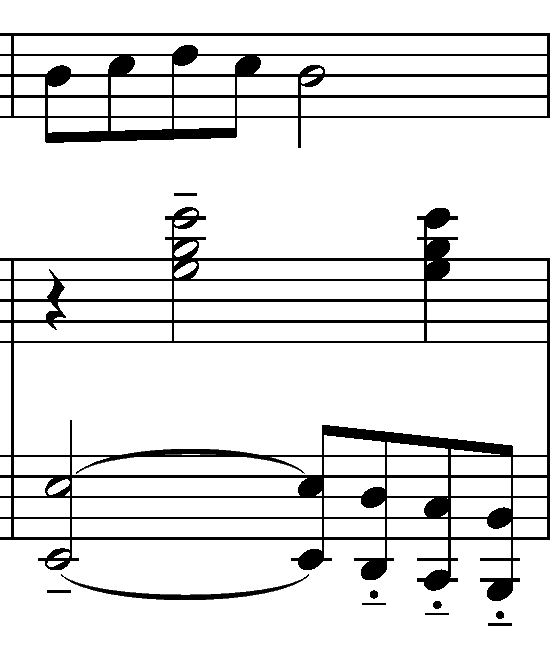
The whole of line 3 will now looks like
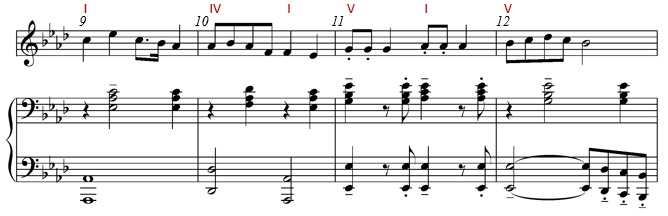
Line 4, we can do the same as line 3 for the first 2 bars. As there are more changes in harmonies towards the concluding 2 bars, we will revert into using what we did on line 2. The whole line will now be

After going through what we can do to each line, the arrangement will be like this:

Piano Accompaniment 鋼琴伴奏 (4)

Download Sheet Music 下載樂譜

Today, we will use hymn 303 Heaven Is Coming as an example.

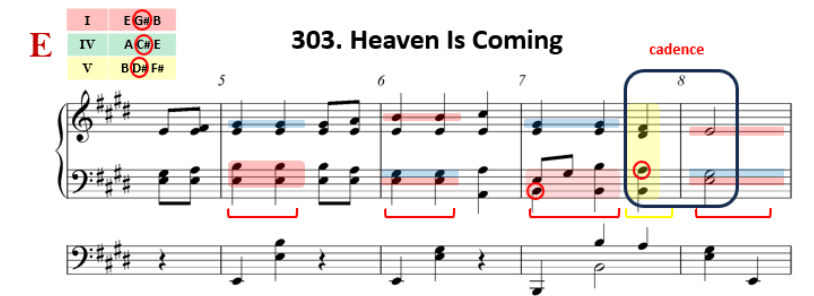
As before, if we just look at the 1st 2 beats of each bar, they are all chord I – E G# B. If we highlight the 3rd G# in blue, so either the melody or the accompaniment will have the third G#, but not both.

Bar 1 > melody is G#, so left hand chord will use E and B.

Bar 2 > melody is B, left hand will use E and G#.

Bar 3 > melody is G#, this time the bass note is B, so a B for the bass.

End of bar 3 to bar 4 is called a cadence, just like punctuation in writing, we will use one more chord in this bar to indicate it is a cadence. This is chord V with a 7th, left hand will use D# and A.

Bar 4 > melody is E, left hand will use E and G#.

Same harmonies as line 1 for bars 5 to 8, this time we will use what we have learnt previously, left hand plays a bass follows by a 2 notes chord.

As line 1 and line 2 are exactly the same, we can actually bring in more contrast by playing an octave higher for line 1. Lyric for line 1 says heaven is coming, so playing an octave higher will help to illustrate this point.

Lyric for line 2 says be a good tree bearing good fruits, bringing the melody back down to normal is like planting the tree firmly on the ground.

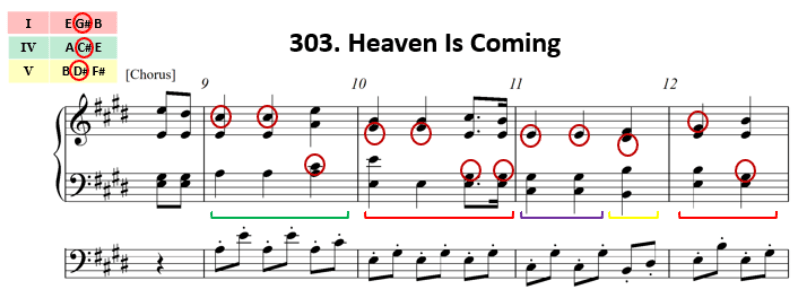
First look at the harmonies, b9 is IV, b10 is I, b11 has a new chord C# E G# is chord VI, follows by a V, b12 is chord I again. Now, highlight all the thirds of each chord, basically, if the melody has the third, the accompaniment will not have the third, and vice versa.

1st line of chorus, bars 9 to 12 tells of Jesus’ great atoning forgiving blood, we will use Staccato quavers to echo us jumping with joy and happiness.

Bar 9 > A and E first, on the 3rd beat change the E to C#.

Bar 10 > as there is no third G# on the melody, left hand can have E and G#.

Bar 11 > 2 chords C# and G# follows by B and D#.

Bar 12 > E and B follows by E and G#.

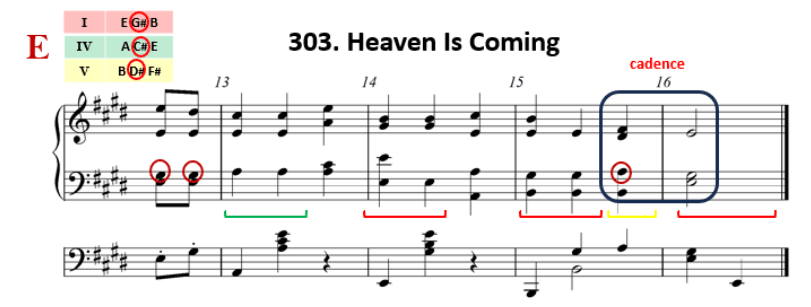
2nd line of the chorus, bars 13 to 16, we will use the bass note and 3 notes chord.

Bar 13 > chord IV, bass note A and a chord.

Bar 14 > chord I, same again bass note E and a chord.

Bar 15 > adds an extra chord for the final cadence to make it sounds complete, chord I with bass B and a chord, follows by chord V, a dominant 7th with an A.

Bar 16 > chord I, reverse, a chord first then a bass E.

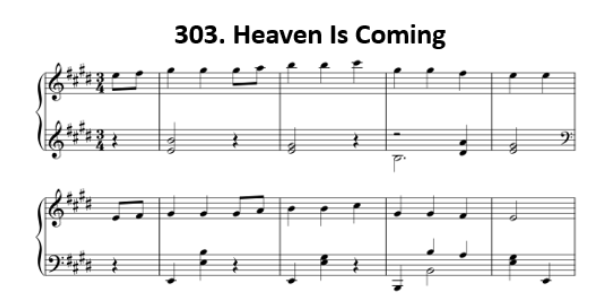
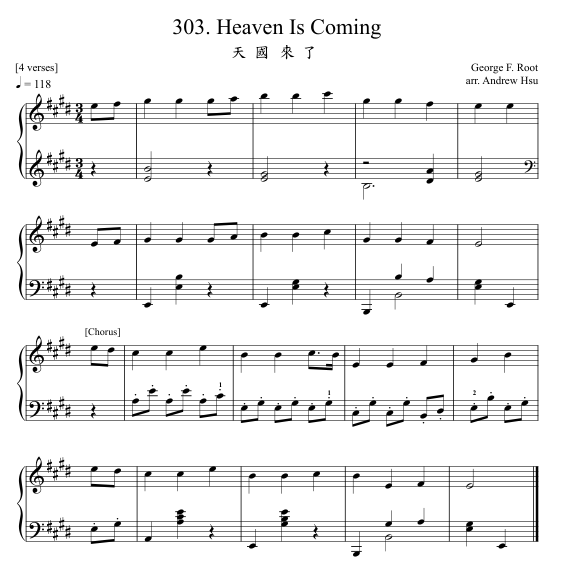
After going through what we can do for each line, the score will be like this